In 2022, the World Health Organisation (WHO) highlighted the fact that 81% of adolescents and young adults were physically inactive, failing to meet WHO recommendations.
This alarming number has pushed the EFCS to act accordingly to its values and enhance physical activity for young adults. The REACT initiative, co-funded by the Erasmus+ Sport programme, aims to address this decline in physical activity during critical life transitions, such as entering higher education and the professional world. Recognising the established benefits of physical activity for mental and physical health through the previous EFCS project Work, Move & Perf (WMP), the project aims to understand why individuals often discontinue such activities during their transition from student to working life while pressure increases at the same time.
Active design as the solution?
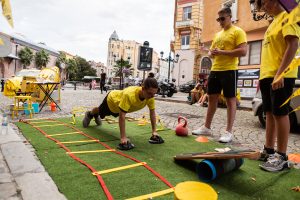
The project came with a focus on active design as a lasting solution as it is rooted in the belief that the physical environment can profoundly influence human behaviour. REACT aims at using innovative active design, nudge techniques, and placemaking strategies to transform study and work environments into dynamic, activity-friendly spaces that enhance physical health, mental well-being, and performance. Throughout this solution, the project seeks a profound transformation in individuals’ relationships with their bodies, their environment and physical activity, promoting the concept of physical literacy encompassing psychological, physical, psychic, and social aspects for a more active lifestyle.
A scalabale solution
The objective is to set up a framework to develop the solution at a European scale, emphasising the possibilities for local organisations to adapt it to their needs. By bridging research and real-world application, REACT offers a sustainable, innovative solution to promote active lifestyles and improve the health and productivity of Europe’s youth. The pilot tests target around 500 individuals, with an expected satisfaction rate exceeding 90% and notable improvements in both physical fitness and mental clarity. Preliminary evaluations indicate that the interventions could reduce sedentary behavior by up to 60%, fostering a more active and engaged population. Leveraging interdisciplinary expertise and robust digital tools, REACT will deliver actionable, evidence-based strategies that are scalable across Europe.
The team
EFCS has chosen to be surrounded by experts of active design from the “Bulgaria Be Active (BGBA)” organisation. In 2017, they lunched the first national placemaking project “Spot Bulgaria” to improving public spaces to become more suitable for sports activities, recreation and physical activity. At the same time the project had strong action on improving the environment for the local communities while promoting active citizenship. With this experience, they will have no difficulties finding the most relevant active design adapted to the partner’s needs.

The University of Eindhoven through its Urbanism and Architecture research group will accompany BGBA for the state-of-art of active design in workplaces and the qualitative study at the end assessing the pilot tests.
The two pilot tests will be implemented in France and in Portugal. In the Bank of France building the active design initiative is supported by its sport association (ASBF).

For Portugal, it is the National Student Sport Federation (FADU) that carries this initiative and it will be tested in the University of Coimbra. Both tests will last 2 months in order to get the real impact.
The University of Copenhagen is also involved in the project to ensure the desk research leading to the final scientific publication.

Finally, the European Student’s Union (ESU) joins the project to monitor all the communication needs (project identity, supports, webpage…) for the project to gain visibility and legitimacy as to our expected results.
Promising outcomes
With a strong and experienced consortium, REACT holds all the cards to find relevant and scalable solutions for the young European population to keep the recommended levels of physical activity. It is an important approach as most of the studies or projects forget to target the youth while they need to be less sedentary as much as older workforces do.